Does Washing Your Pillowcase Actually Kill Bacteria?
The short answer
Mostly, but not completely. Household washing machines clean fabric but don’t sterilize it. At lower temperatures without bleach, some bacteria survive and can spread to other items in the load. A hot wash, an oxygen bleach or a hot dryer cycle removes much more.
What washing does, and doesn’t do
In a 2015 study of household washing machines, researchers put it plainly: washing machines “launder soiled clothes and textiles, but do not sterilize them.” Nearly all the bacterial groups found on a cotton sample before washing were still present after it.
What temperature should you wash pillowcases at?
Yes. In a 2017 study, a 40°C (104°F) wash removed most bacteria from fabric, but some survived and spread to clean fabric in the same load. A 60°C (140°F) wash removed them completely. A 2020 lab study found that without bleach, washing above 60°C was needed to reach a 99.9% kill rate, while bacteria survived low-temperature washes.
Does bleach help?
Oxygen-based bleach makes a big difference at lower temperatures. In the same 2020 study, all tested bacteria were eliminated in washes under 40°C when activated oxygen bleach was added. A laundry hygiene review notes that the shift toward cooler washes and bleach-free liquid detergents has reduced how well home laundry kills germs.
Should you wash pillowcases with towels or clothes?
They can. The 2017 study saw bacteria move to clean fabric during a 40°C wash, and the 2015 study found that bacteria on the textiles going in made up a large part of what was found on textiles coming out. Washing pillowcases with towels or gym clothes at a low temperature means sharing whatever is on them.
Does the washing machine kill bacteria, or spread it?
It can. A 2017 German study detected antibiotic-resistance genes in 79% of the household washing machines it sampled, and a laundry hygiene review notes that rinse water can carry microbes from the machine’s detergent drawer onto clean laundry. Cleaning the drawer and door seal and running an occasional hot empty cycle helps.
How to wash pillowcases in a washing machine
- Use the hottest water the care label allows, ideally 60°C (140°F) for cotton.
- Add an oxygen bleach if you wash cooler and the fabric allows it.
- Wash pillowcases separately from towels and workout clothes.
- Dry completely, on high heat if the label allows.
- Keep the machine clean: wipe the drawer and door seal and leave the door open to dry.
Even a perfectly washed pillowcase starts collecting bacteria again the first night, which is why dermatologist Marisa Garshick, MD, suggests changing it every two to three days if you’re acne-prone. More in our Pillow Acne guide.
A fresh surface every night, without the laundry
Washing hot, separately and often works, but it’s a lot of laundry, and silk or delicate pillowcases can’t take the heat.
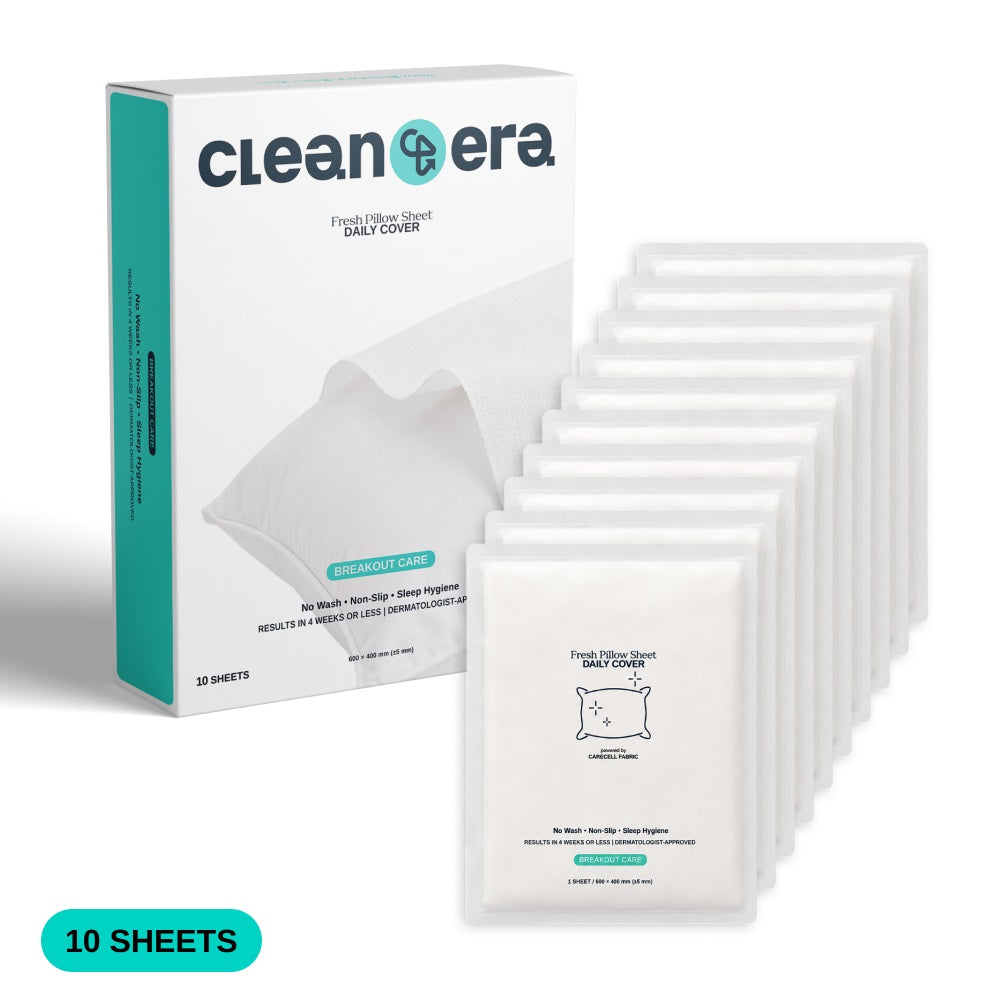
The Clean Era Daily Pillow Sheet is made for acne-prone skin. It’s a thin sheet of soft, breathable cellulose fabric that you lay over your pillow at night and toss in the morning, so your face starts on a surface no one has slept on. The fabric is antibacterial-treated: in an 18-hour lab test, CareCell™ fabric inhibited the growth of C. acnes bacteria by 99.9%.* The finished sheet scored 0.00 for skin irritation in a 33-person patch test.**
Join the waitlistLaunching November 2026
*Lab test on CareCell™ fabric, 18 hours, KS K 0693. **24-hour patch test on the finished sheet, 33 participants.
Frequently asked questions
How long can bacteria live on a pillowcase?
Weeks. In a 2017 lab study, E. coli and S. aureus survived on cotton and polyester for up to three weeks.
Is my pillowcase dirtier than a toilet seat?
You’ll see that claim online, but it comes from a report by a mattress company, not peer-reviewed research. Published studies do show bacteria and fungi build up on bed linen within a week.
What temperature kills bacteria in laundry?
In studies, 60°C (140°F) removed bacteria from fabric completely, while 40°C (104°F) left some behind unless an oxygen bleach was used.
Should I use fabric softener on pillowcases?
It isn’t needed, and scented softeners may irritate sensitive skin. See Can fabric softener cause breakouts?
Does laundry detergent kill bacteria?
Not reliably on its own. Researchers describe household washing machines as cleaning fabric but not sterilizing it. In studies, water temperature and oxygen bleach made the biggest difference in how many bacteria survived.
What temperature should you wash silk pillowcases at?
Follow the care label, which usually calls for cold water. Because a cool wash removes fewer bacteria, change silk pillowcases just as often as cotton.
Should you wash a new pillowcase before using it?
Yes. The American Academy of Dermatology suggests washing new clothes before wearing them to remove excess dyes and fabric finishers that can irritate skin, and the same logic applies to a new pillowcase.
Sources
- Callewaert C, et al. Bacterial exchange in household washing machines. Frontiers in Microbiology, 2015. pubmed.ncbi.nlm.nih.gov/26696989/
- Riley K, et al. The effect of low-temperature laundering and detergents on the survival of E. coli and S. aureus on textiles used in healthcare uniforms. Journal of Applied Microbiology, 2017. pubmed.ncbi.nlm.nih.gov/28489297/
- Shin M, Park H, Park W. Sterilization efficiency of pathogen-contaminated cottons in a laundry machine. Journal of Microbiology, 2020. pubmed.ncbi.nlm.nih.gov/31768938/
- Bockmühl DP. Laundry hygiene: how to get more than clean. Journal of Applied Microbiology, 2017. doi.org/10.1111/jam.13402
- Rehberg L, et al. Prevalence of β-lactamase genes in domestic washing machines and dishwashers and the impact of laundering processes on antibiotic-resistant bacteria. Journal of Applied Microbiology, 2017. pubmed.ncbi.nlm.nih.gov/28845592/
- Cayrou C, et al. From clean to colonized: microbial dynamics of bed linen over time. Letters in Applied Microbiology, 2026. pubmed.ncbi.nlm.nih.gov/42747176/
- Parade. How Often Should You Change Your Pillowcase? With Marisa Garshick, MD, and aesthetician Kristin Gunn, 2025. parade.com/health/how-often-should-you-change-your-pillowcas…
- American Academy of Dermatology. Atopic dermatitis: self-care. www.aad.org/public/diseases/eczema/types/atopic-dermatitis/s…
This article is for general information and isn’t medical advice. The researchers and experts cited here did not test or endorse Clean Era.