Can Fabric Softener Cause Breakouts?
The short answer
There’s no research showing that fabric softener or detergent clogs pores or causes acne. What is documented is irritation: the American Academy of Dermatology says scented fabric softener or dryer sheets may contribute to skin irritation. If you get an itchy rash where fabric touches you, it’s more likely contact dermatitis than acne.
Does fabric softener or fabric conditioner clog pores?
You’ll find this claim on many skincare sites, but we couldn’t find a study that supports it. Fabric softeners work by leaving a coating of conditioning ingredients, often quaternary ammonium compounds, on the fibers. Whether that coating transfers to skin in amounts that affect pores hasn’t been studied. In a small 2011 trial of softener-treated T-shirts, researchers reported no remarkable side effects.
Can laundry detergent cause acne or a rash?
The AAD lists detergents among common causes of irritant contact dermatitis, and fragrance among the most common causes of allergic contact dermatitis. For sensitive skin it suggests a detergent made for sensitive skin, and notes that scented fabric softener or dryer sheets may contribute to irritation.
True detergent allergies seem to be uncommon. A 2025 review of patch-test research cited a study of more than 700 patients in which laundry detergent could have been the cause of allergic contact dermatitis in less than 0.7% of them.
Is it acne or a laundry rash?
They look and feel different. Contact dermatitis often starts with itchy skin, sometimes intensely, followed by a rash that can be discolored, swollen or tender, and sometimes blisters. Acne shows up as blackheads, whiteheads and pimples and usually isn’t itchy.
| Acne | Contact dermatitis | |
|---|---|---|
| Itch | Usually not itchy | Often itchy, sometimes intensely |
| Looks like | Blackheads, whiteheads, pimples | Rash, swelling, sometimes blisters |
| Where | Face, chest, back | Wherever the trigger touched |
If you’re not sure, a board-certified dermatologist can tell the difference and, if needed, patch test to find the cause.
The best laundry routine for acne-prone skin
- Use a fragrance-free, dye-free detergent. The AAD recommends this for eczema-prone skin, and it removes one possible irritant.
- Use only the recommended amount and enough water to rinse well.
- Skip fabric softener and dryer sheets on pillowcases. They aren’t needed for hygiene.
- Wash hot if the label allows, and change pillowcases every two to three days.
More on pillowcase hygiene in our Pillow Acne guide.
A fresh surface every night, without the laundry
A pillowcase that’s never been washed has no detergent or softener on it, and no buildup from the nights before.
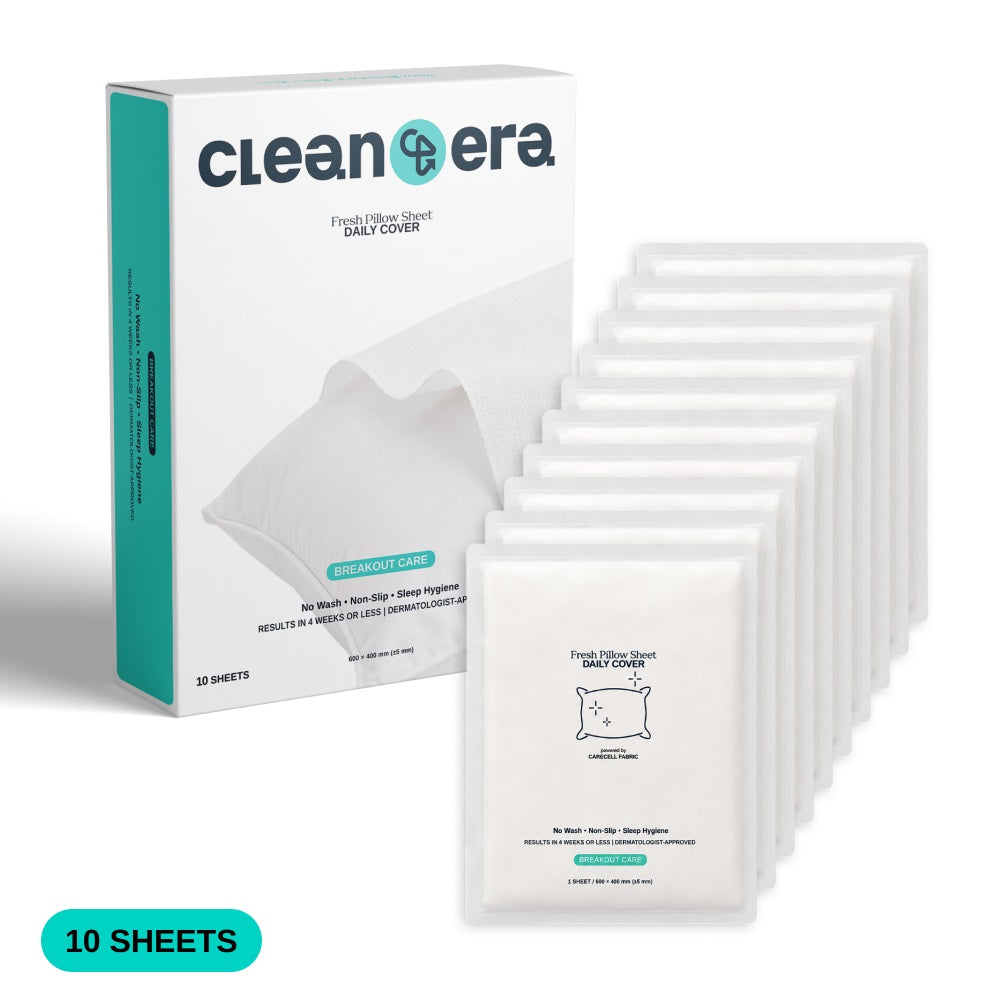
The Clean Era Daily Pillow Sheet is made for acne-prone skin. It’s a thin sheet of soft, breathable cellulose fabric that you lay over your pillow at night and toss in the morning, so your face starts on a surface no one has slept on. The fabric is antibacterial-treated: in an 18-hour lab test, CareCell™ fabric inhibited the growth of C. acnes bacteria by 99.9%.* The finished sheet scored 0.00 for skin irritation in a 33-person patch test.**
Join the waitlistLaunching November 2026
*Lab test on CareCell™ fabric, 18 hours, KS K 0693. **24-hour patch test on the finished sheet, 33 participants.
Frequently asked questions
Can laundry detergent cause acne?
There’s no research showing it does. Detergents can irritate skin or, less commonly, cause an allergic rash, which is different from acne.
What does a rash from fabric softener look like?
Usually an itchy rash where the fabric touches you, sometimes with swelling or blisters. It often appears hours or days after contact.
What’s the best laundry detergent for acne-prone skin?
No detergent has been shown to help acne. A fragrance-free, dye-free detergent is the gentlest choice, especially if your skin is also sensitive.
Can dryer sheets cause acne?
There’s no research showing they do. The AAD notes scented fabric softener or dryer sheets may contribute to skin irritation, so skipping them on pillowcases is an easy change if your skin is sensitive.
Can laundry detergent cause back acne?
No study shows detergent causes back acne. Back breakouts are more often linked to sweat, friction and tight clothing, so look at those first.
Sources
- American Academy of Dermatology. Atopic dermatitis: self-care. www.aad.org/public/diseases/eczema/types/atopic-dermatitis/s…
- American Academy of Dermatology. Contact dermatitis: signs and symptoms. www.aad.org/public/diseases/eczema/types/contact-dermatitis/…
- American Academy of Dermatology. Contact dermatitis: causes. www.aad.org/public/diseases/eczema/types/contact-dermatitis/…
- Puch E, et al. Hypersensitivity reaction to detergents: a myth or reality? Acta Dermatovenerologica Croatica, 2025. pubmed.ncbi.nlm.nih.gov/41178659/
- Isoda K, et al. Treatment of cloth with a fabric softener ameliorates skin dryness. Journal of Dermatology, 2011. pubmed.ncbi.nlm.nih.gov/21729145/
- National Eczema Association. all free clear Fabric Softener (ingredient listing). nationaleczema.org/eczema-products/allr-free-clear-fabric-so…
- Parade. How Often Should You Change Your Pillowcase? With Marisa Garshick, MD, and aesthetician Kristin Gunn, 2025. parade.com/health/how-often-should-you-change-your-pillowcas…
This article is for general information and isn’t medical advice. The researchers and experts cited here did not test or endorse Clean Era.