Silk vs Cotton Pillowcases for Acne: What the Research Says
The short answer
No published research shows that silk pillowcases reduce acne. The only completed clinical trial tested a silk-like synthetic fabric against cotton, and the silk-like pillowcase didn’t come out ahead. Silk is smoother, cotton can be washed hotter, and for either one, how often you change it matters more than the fabric.
What the clinical trial found
In a 12-week randomized trial registered on ClinicalTrials.gov, 40 people with acne slept on either a “silk-like” pillowcase or a cotton one. The silk-like fabric wasn’t real silk: it was about 50% polyester and 50% nylon, with an antimicrobial finish. Total lesion counts fell 13.1% in the silk-like group and 21.7% in the cotton group. The study was small, the ranges overlapped, and the researchers noted that results were limited by the low number of participants.
A trial of real mulberry silk versus cotton has been registered, but no results have been posted.
Is silk naturally antibacterial?
Not on its own. A 2014 study found that properly purified silk fiber had no inherent resistance to E. coli, and that earlier reports of antibacterial silk were likely due to chemical residues left from processing.
Do satin or silk pillowcases help acne by reducing friction?
Possibly, but it hasn’t been tested for acne. Friction and pressure can make breakouts worse (acne mechanica), and silk feels smoother than cotton. Fabric type also changes how much bacteria reaches skin: in a 2022 lab study comparing cotton, polyester and a cotton-polyester blend, 100% polyester attracted the most bacteria and released the most onto a skin-like surface. Silk wasn’t tested, but many satin pillowcases are polyester.
Which is easier to keep clean?
Cotton. Washing at 60°C (140°F) removed bacteria from fabric completely in a 2017 study, and cotton can usually take that heat. Silk care instructions typically call for cold water and a gentle cycle, and at lower temperatures some bacteria can survive a wash.
| Silk | Cotton | Satin (often polyester) | |
|---|---|---|---|
| Feel | Smoothest | Soft, more texture | Smooth |
| Hot wash | Usually no | Usually yes | Check label |
| Price | Highest | Low | Low to mid |
| Shown to reduce acne? | No published evidence | No published evidence | No published evidence |
So what’s the best pillowcase for acne-prone skin?
Pick the fabric you like sleeping on and can keep clean. If you choose silk for comfort, plan on enough pillowcases to change every two to three days. If you choose cotton, wash it hot. Either way, a fresh pillowcase does more for acne-prone skin than an expensive one used for a week.
More in our Pillow Acne guide.
A fresh surface every night, without the laundry
Whatever the fabric, the advice is the same: a fresh surface every two to three days. That’s where most of us fall behind.
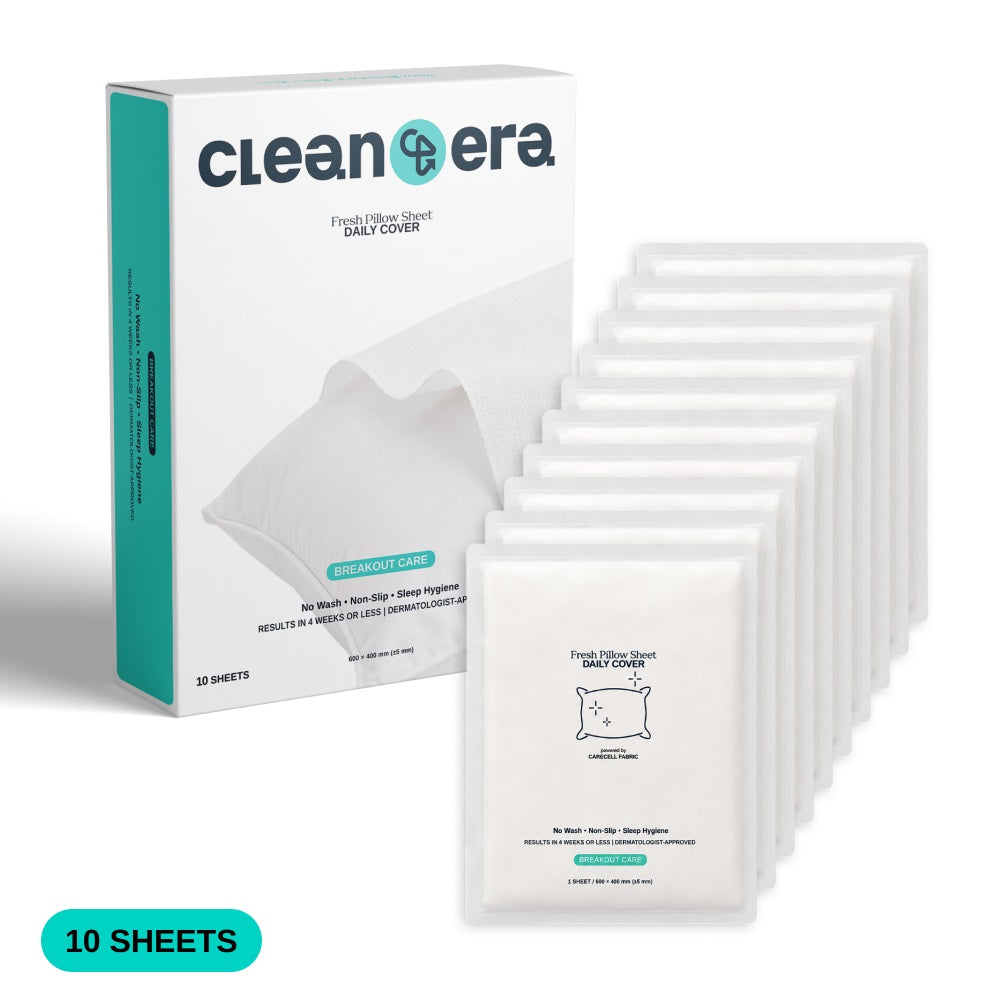
The Clean Era Daily Pillow Sheet is made for acne-prone skin. It’s a thin sheet of soft, breathable cellulose fabric that you lay over your pillow at night and toss in the morning, so your face starts on a surface no one has slept on. The fabric is antibacterial-treated: in an 18-hour lab test, CareCell™ fabric inhibited the growth of C. acnes bacteria by 99.9%.* The finished sheet scored 0.00 for skin irritation in a 33-person patch test.**
Join the waitlistLaunching November 2026
*Lab test on CareCell™ fabric, 18 hours, KS K 0693. **24-hour patch test on the finished sheet, 33 participants.
Frequently asked questions
Which pillowcase material is best for acne?
No fabric has been shown to reduce acne. The best choice is one you can change every two to three days and wash properly.
Are silk pillowcases good for acne-prone skin?
They’re smooth and comfortable, but there’s no published evidence they reduce acne, and they usually can’t be washed hot.
What do dermatologists say about silk pillowcases?
Dermatology advice focuses on changing your pillowcase often. Dermatologist Marisa Garshick, MD, suggests every two to three days for acne-prone skin. Curology’s medically reviewed guide notes there is no research on which pillowcase types help acne.
Is satin the same as silk?
No. Satin is a weave, and satin pillowcases are often made of polyester. Silk is a natural fiber.
Can a silk pillowcase cause acne?
Silk itself isn’t known to cause acne, but any pillowcase that isn’t changed often collects oil and bacteria. Because silk is usually washed cool, keeping it clean takes frequent changes.
Is a polyester satin pillowcase bad for acne?
There’s no acne study on it. In one lab study, 100% polyester attracted and released the most bacteria of the fabrics tested, so if you use polyester satin, change it often.
Are there before-and-after results for silk pillowcases and acne?
Not from published studies. Before-and-after photos online are individual experiences, and other changes like new skincare can affect the result.
Sources
- Wake Forest University Health Sciences. Efficacy of silk-like bedding fabric pillow case in the treatment of acne vulgaris (NCT00767104). ClinicalTrials.gov, results posted 2017. clinicaltrials.gov/study/NCT00767104
- Silk vs cotton pillowcase study (NCT06142487). ClinicalTrials.gov. clinicaltrials.gov/study/NCT06142487
- Kaur J, et al. Facts and myths of antibacterial properties of silk. Biopolymers, 2014. pubmed.ncbi.nlm.nih.gov/23784754/
- Mallick D, Gupta D, Sharma S. Transfer of bacteria between fabric and surrogate skin. American Journal of Infection Control, 2022. pubmed.ncbi.nlm.nih.gov/34774893/
- Mills OH Jr, Kligman A. Acne mechanica. Archives of Dermatology, 1975. pubmed.ncbi.nlm.nih.gov/123732/
- Riley K, et al. The effect of low-temperature laundering and detergents on the survival of E. coli and S. aureus on textiles used in healthcare uniforms. Journal of Applied Microbiology, 2017. pubmed.ncbi.nlm.nih.gov/28489297/
- Parade. How Often Should You Change Your Pillowcase? With Marisa Garshick, MD, and aesthetician Kristin Gunn, 2025. parade.com/health/how-often-should-you-change-your-pillowcas…
- Curology. How often should I change my pillowcase to help prevent acne? Medically reviewed, 2023. curology.com/blog/how-often-should-i-change-my-pillowcase-to…
This article is for general information and isn’t medical advice. The researchers and experts cited here did not test or endorse Clean Era.